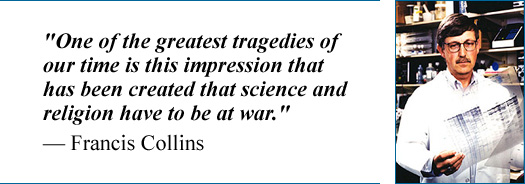
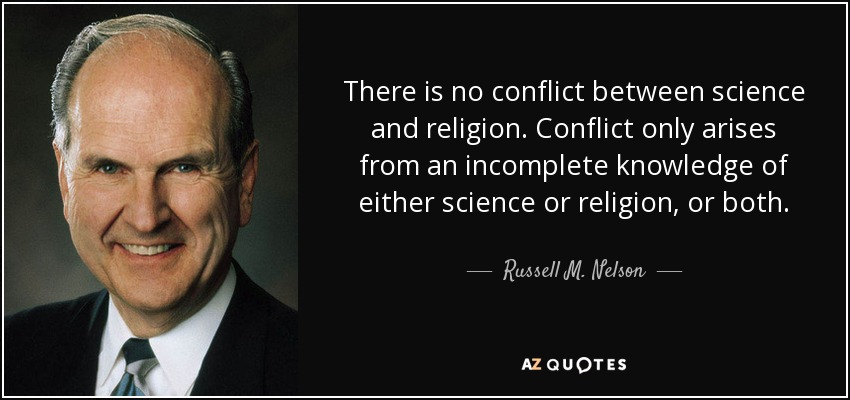
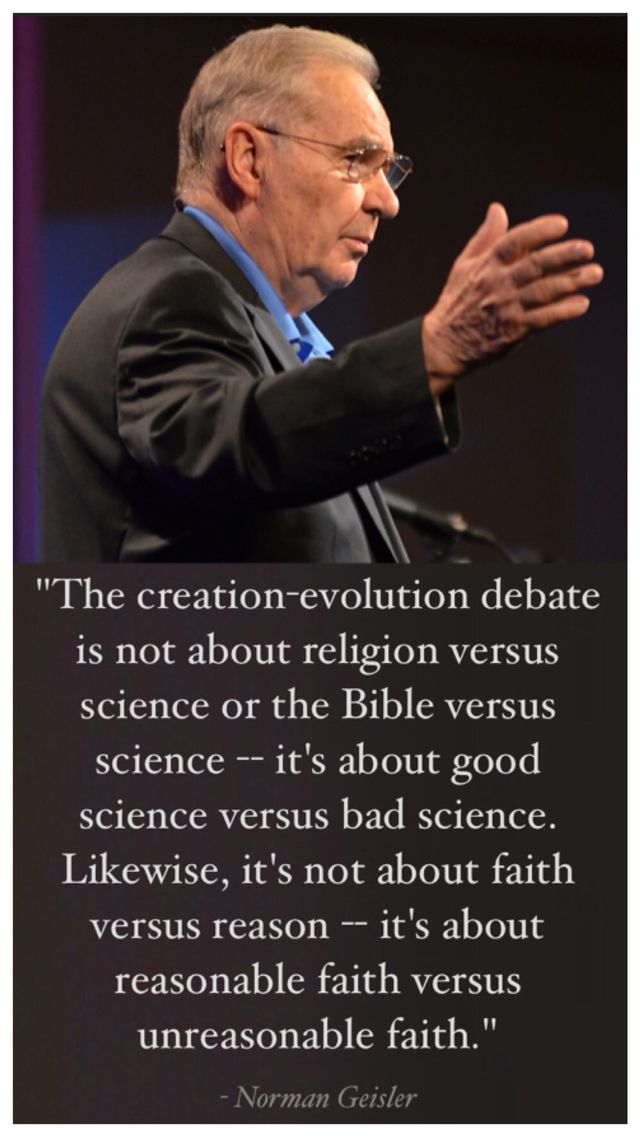
Is there a war between Christianity and Science?
A little history lesson will help to answer this question. While some early Christian thinkers grew up with classical Greek thinking, mostly there was a wide gap between Christian and pagan thinking. Christianity did not just melt into the syncretistic hodge-podge thinking of the Roman Empire.
To most residents of the Greco-Roman world, the supernatural world of gods, goddesses, omens, curses and astrology blended together. The common man lived his life under the constant danger of interference by these supernatural powers. They also believed in cyclical time, the conviction that history repeats itself in time periods. So, if a few good things happened to you, some bad things would happen also. The time period might be longer but the results would be the same. Some people also believed that the gods controlled everything. If you wanted a good crop the coming season, you’d offer a sacrifice of some kind to the god of agriculture. If you didn’t offer the right sacrifice, that god would be dis-pleased and you might have a bad crop. The problem was these gods were capricious. They got mad, often with other gods. They had human emotions, were lustful, etc., but they were much more powerful than humans. Many times the gods would war among themselves. Some pagans also believed that their life was already set out before them and they couldn’t change it. Their destiny was fixed by the stars (astrology). This belief is called determinism and it is very fatalistic.

On the other hand, Christians worshipped a personal, rational, loving and consistent God. He wasn’t capricious. They also believed time was not cyclical but linear. It had a direction. Jesus had come once for our salvation. He didn’t need to come back several times for the same thing. God was also separate from His creation. Christians appreciated nature but didn’t worship it. They also didn’t believe in determinism (astrology). They practiced personal responsibility because the bible taught it. They embraced progress because they saw it as being obedient to the creation mandate of Genesis 1, “to rule over creation”. They also believed that God takes a personal interest in His creation as this is what the bible teaches also. Eventually, Christianity came to believe in scientific progress. They posited that their rational God would create the universe according to rational laws. So they wanted to “think God’s thoughts after Him” according to Kepler.
All of these things gave Christianity a huge edge over other civilizations in their pursuit of knowledge. Many other cultures (Greek, Muslims, etc.) indulged in scientific exploration, often with impressive results, but they’re efforts stagnated or got lost because of their views of God and creation. Within 3 or 4 generations, Europe (western civilization) with it’s Christian foundations left the other cultures far behind. It has never lost its momentum.
The Middle Ages saw an explosion of knowledge in every area of life…machinery, medicine, farming, etc. Because of Christianity’s compassion and God’s command to care for and heal the sick, Christians started hospitals, schools, orphanages, soup kitchens, etc. for the poor and common man. Sexuality was elevated even if believers weren’t always consistent in it. The rights of women were elevated far above what they had been under Greeks, Romans, Egyptians or barbarians.
For more on this, read Dr. Alvin Schmidt’s book “How Christianity Changed the World”.
Also read http://www.faithfacts.org/christ-and-the-culture/the-impact-of-christianity.

Almost all the Middle Age scientists were priests, clerics or Christians. Monasteries had been keepers of ancient scrolls. Universities grew out of monasteries. Unlike in centuries past, anyone could attend these schools. Anselm, Thomas Aquinas, Copernicus and Galileo were all clerics. Almost all scientists, thru the mid-1800’s expressed their scientific discoveries in religious terms.
Here’s a partial list of scientists who were Christians:
Robert Grosseteste Galileo John Dalton
Roger Bacon William Harvey Andre Ampere
Nicholas Copernicus Blaise Pascal Georg Ohm
Leonardo da Vinci Robert Boyle Michael Faraday
Andreas Vesalius Isaac Newton Louis Pasteur
Tycho Brahe Antoine Lavoisier Lord Kelvin
Johann Kepler Alessandro Volta Joseph Lister
George Washington Carver
Were there vigorous debates on certain subjects? Of course there were. And there were Christians on both sides. Unfortunately, some people, including a Pope or two, made some stupid statements and did some stupid things. But science advanced more, by far, under Christendom than any other system. The case of Galileo is often trotted out by atheists and secularists to prove that Christianity is anti-science. But the facts show no such thing. Galileo’s problem was more political than scientific. Yes, he was arrested and put under house arrest, but he was given a good amount of freedom. His crime? Basically, he publicly dissed the Pope. For details on this, check out “Christianity on Trial” by Shifflett and Carroll, pages 54-56, 73-76 and “What’s So Great about Christianity” by D’Sousa, pages 103-111. Here is a catholic response from their own archives…
https://www.catholic.com/tract/the-galileo-controversy.
And one from a non-catholic source…
https://creation.com/the-galileo-affair-history-or-heroic-hagiography.
More than 90 years ago, the great mathematician and philosopher of science, Alfred Lord Whitehead, said that modern science came from the Medieval’s insistence on the rationality of the Christian God. Medieval cathedrals were transformed into the most sophisticated solar observatories in the world. The Catholic church gave more financial and social support to the study of astronomy for over 6 centuries than any other institution. Pope Alexander VIII (1610-1691) became the major patron of scientists. Isaac Newton, thought to be the greatest scientist who ever lived, wrote way more on biblical and theological topics than he did on science, even though he had misgivings about Jesus’ divinity later in his life. The usual reaction of these early scientists, most of whom were Christians, was to marvel at the orderliness of God’s creation. The first and most prestigious society of science in the world, The Royal Society of London (founded in 1645), consisted of 10 members, 7 of which were Puritans. Yes, that’s right, those Puritans who later emigrated to America.
But by the mid-1800’s, things became to change. There were 4 men who turned the sciences against Christianity. Charles Darwin, Thomas Huxley, John William Draper and Andrew Dickson White. John William Draper wrote a book in 1874 entitled “History of the Conflict between Religion and Science. Andrew Dickson White, first President of Cornell University, wrote a 2 volume “A History of the Warfare of Science with Theology in Christendom” in 1896. The source documents for both books have been discredited. Historians are virtually unanimous in saying that the whole science versus religion story is a 19th century fabrication. But these books were popular with the common person. To this day, many people believe the Medieval church taught that the Earth was flat until science showed an uneducated clergy that the Earth was round, Forget the fact that the ancient Greeks proved the Earth was a sphere, that anyone could see the Earth’s shadow on the Moon during a lunar eclipse and that anyone could see ships sailing over the horizon would disappear. The Flat Earth theory was a late 19th century fabrication attributed to creationists to make them look foolish. Creationists have NEVER believed this.
Draper and White’s fictitious war between science and religion made it into American textbooks, despite the protestations of historians. Americans were being brought up on lies about science and religion. The old saying that “a lie in the morning makes it half-way around the globe before the truth has put it’s shoes on” came true.
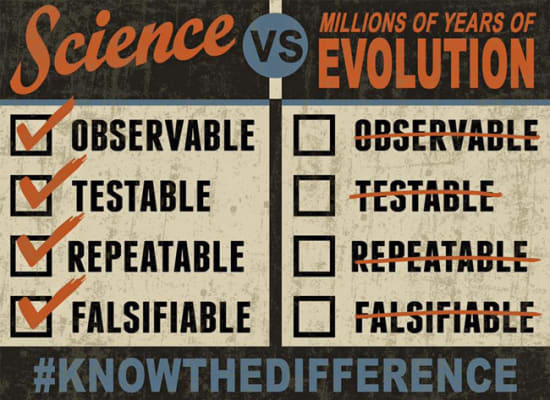
Charles Darwin published his “Origin of Species” in 1859. He presented natural selection as a patient process by which such marvels of “design” could happen without a Designer as the cause. While Darwin stressed the similarities between species, creationists stressed the differences. At first, some scientists took a wait and see attitude towards evolution. But many Christians and some scientists opposed it. Other scientists (including some Christians) and the “free thinkers” (the atheists and agnostics) seized on the opportunity and launched a frontal assault on religious belief. Thomas Huxley, a biologist and atheist, lead the charge. He wasn’t called “Darwin’s Bulldog” for nothing. While Darwin’s theory of evolution was interesting and did make some valid comparisons, it had some valid opposition to it. It had also predicted that we would find thousands of transitional fossils. Darwin even said if they didn’t find these thousands of transitional fossils, his theory would be proven wrong. Guess what? We haven’t found any! Oh, there have been that have claimed to be transitional fossils, but they have all been disproven. The fact that in over 160 years, we haven’t found any is a serious blow to evolution. The evolutionists battle cry 100 years ago was to teach evolution alongside creationism in the public schools. Now that they have gained near dominance, they won’t allow creationism or intelligent design to be taught in the public schools. 100 years ago, they recognized creationism as a valid scientific theory. Today they don’t. The hypocrisy of this is amazing.


But the tide may be slowly turning. Two discoveries have brought this about. One is the realization that our universe is expanding. This has lead scientists to say hat the universe had a beginning from which to expand. The second is the absolutely fantastical fine-tuning of the universe’s physical constants. For example, if the force of gravity had been a little stronger, most stars would have burned out long ago, including our own Sun. If gravity had been a little weaker, galaxies, stars and planets would never have formed. English physicist and mathematician Roger Penrose estimated the odds of our physical constants being exactly balanced by random chance, it would be one chance in 10300 power. That’s the number 1 followed by 300 zeros. This number is wayyyy beyond impossible. To get around this impossibility, a few scientists have posited the multi-verse theory. This says that there is a universe-making “machine” that makes trillions upon trillions of universes. One of them is bound to have the right physical constants for life. To exist. This is insane to come from normally intelligent scientists. Of course, we cannot observe these other universes, so their existence is merely speculation. This alone takes it out of the realm of science. I guess people, even a few scientists, will go to any length to get away from the possibility of a Creator. Let’s hear from a few other scientists…
“Scientists are slowly waking up to an inconvenient truth – the universe looks suspiciously like a fix. The issue concerns the very laws of nature themselves. For 40 years, physicists and cosmologists have been quietly collecting examples of all too convenient “coincidences” and special features in the underlying laws of the universe that seem to be necessary in order for life, and hence conscious beings, to exist. Change any one of them and the consequences would be lethal. Fred Hoyle, the distinguished cosmologist, once said it was as if “a super-intellect has monkeyed with physics”. Physicist Paul Davies
“Scientists who utterly reject Evolution may be one of our fastest-growing controversial minorities… Many of the scientists supporting this position hold impressive credentials in science.” Larry Hatfield, “Educators Against Darwin,” Science Digest Special (Winter 1979), pp. 94-96.
“Darwinism has never had much appeal for science outside of the English-speaking world, and has never appealed much to the American public (although popular with the U.S. scientific establishment in the past). However, its ascendancy in science, in both Britain and America, has been waning for several decades as its grip has weakened in successive areas: geology; paleontology; embryology; comparative anatomy. Now even geneticists are beginning to have doubts. It is only in mainstream molecular biology and zoology that Darwinism retains serious enthusiastic supporters. As growing numbers of scientists begin to drift away from neo-Darwinist ideas, the revision of Darwinism at the public level is long overdue, and is a process that I believe has already started.” Richard Milton, Shattering the Myths of Darwinism (Rochester, Vermont: Park Street Press, 1992, 1997), p. 277.
“…A tidal wave of new books… threaten to shatter that confidence – titles like Darwin Retried (1971), Macbeth; The Neck of the Giraffe: Where Darwin Went Wrong (1982), Hitching; The Great Evolution Mystery (1983), Taylor; The Bone Peddlers: Selling Evolution (1984), Fix; Darwin Was Wrong – A Study in Probabilities (1984), Cohen; Darwinism: The Refutation of a Myth (1987), Lovtrup; and Adam and Evolution (1984), Pitman. Not one of these books was written from a Christian-apologetic point of view: they are concerned only with scientific truth – as was Sir Ernst Chain when he called evolution ‘a fairy tale’.” Richard Milton, Shattering the Myths of Darwinism (Rochester, Vermont: Park Street Press, 1992, 1997), p. 12.
Robert Jastrow (self-proclaimed agnostic and physicist/astronomer): “For the scientist who has lived by his faith in the power of reason, the story ends like a bad dream. He has scaled the mountains of ignorance; he is about to conquer the highest peak; as he pulls himself over the final rock, he is greeted by a band of theologians who have been sitting there for centuries.”
Ed Harrison (cosmologist): “Here is the cosmological proof of the existence of God � the design argument of Paley � updated and refurbished. The fine tuning of the universe provides prima facie evidence of deistic design. Take your choice: blind chance that requires multitudes of universes or design that requires only one…. Many scientists, when they admit their views, incline toward the teleological or design argument.”
For more quotes, go to http://BSSSB-LLC.com/quotations-from-scientists-evolutionists-about-darwinian-evolution/.
So where does all of this leave us?
– evolution cannot explain how life began or how it went from non-living chemicals to humans. It doesn’t seem reasonable to assume that random combinations of chemicals could have produced such a marvelously complex thing like a living cell. Recently we have seen that a single living cell is more complex than all of the world’s factories. And those were intelligently designed.
– evolution cannot explain what consciousness is or how it came about. Virtually nothing is known about the functioning microcircuitry of the brain nor can it explain emotions.
– evolution cannot explain human rationality, the ability to perceive something as true or false.
– evolution cannot explain our morality. It cannot explain why we feel something is morally right or wrong. It cannot explain why we “ought” to feel a certain way.
So, evolution cannot explain:
-the origin of life
-the origin of consciousness
-the origin of human rationality
-the origin of morality
-the process of how the human body came to be
Any theory that cannot account for these basic things can hardly claim to be a theory of origin. There are some things about evolution that are right, there are some things that are wrong. But the theory just doesn’t explain enough. Yet the proponents of evolution are blind to the theory’s weaknesses.

So, after reading this, do you really think there’s a war between science and religion? I think there’s a war alright, but it’s between good science and bad science.
References:
Books;
“Christianity on Trial” by Carroll & Shiflett
“What’s So Great about Christianity?” by Dinesh D’Souza
“How Christianity Changed the World” by Alvin Schmidt
Websites;
http://BSSSB-LLC.com/sciencecreationevolution/
http://godandscience.org
http://BSSSB-LLC.com/was-our-universe-designed-for-life/
http://BSSSB-LLC.com/problems-with-the-big-bang-theory/
http://www.godandscience.org/evolution/index.html
For His Kingdom,
Dave Maynard
http://BSSSB-LLC.com