🌏 Blogs / Articles / News / Classifieds / Press Releases / PSA / Podcast / Poetry / Storytelling

 To expand your news reach, consider advertising with our media partner, Patch Media, at https://heypapipromotionsmedia.town.news/. Patch is a nationwide news network comprising over 1,000 hyperlocal websites dedicated to community news across the United States. For press release distribution services, please call or visit https://heypapipromotions.com/advertise.

📣 Top 10 Christian Press Release Distribution Service in 2025 – Boost Your Faith-Based Message with Hey Papi Promotions

bmc (8)

The Purpose of BMC


The Purpose of BMC

Bulk Molding Compound (BMC) stands as one of the most versatile materials in composite manufacturing, widely used across industries such as automotive, electrical, consumer goods, and industrial equipment. Despite its widespread use, many professionals and learners still seek a clear understanding of the purpose of BMC, how it differs from other molding compounds, and what makes it indispensable for high performance applications.
 

Fundamentals of BMC — Material Science and Functional Role of BMC Molding Compound


What Is BMC and Why It Matters in Modern Composites?

 
Bulk Molding Compound (BMC) refers to a ready-to-use composite material primarily composed of resin (typically unsaturated polyester), reinforcing fibers (commonly glass fibers), fillers, catalysts, and other additives. The term bmc molding compound emphasizes that this material is pre-mixed and formulated for compression molding and related processing.
The purpose of BMC is to combine the mechanical strength associated with fiber reinforcement and the processing flexibility of thermoset resins. Unlike thermoplastics, which melt upon heating, thermoset systems cure irreversibly, yielding components with excellent dimensional stability, heat resistance, and high structural integrity.
 
Key performance attributes of BMC include:
High strength-to-weight ratio
Excellent electrical insulation properties
Good flame resistance
Uniform material distribution in molded parts
Low shrinkage and superior dimensional accuracy
These properties make bulk molding compound BMC essential for applications where reliability, repeatability, and cost-effective mass production converge. In sectors such as automotive and electronics, BMC parts often replace metal or ceramic components, delivering weight savings and corrosion resistance while meeting stringent regulatory and performance requirements.
 

Chemical Composition and Structural Dynamics

 
At a molecular level, the resin matrix in BMC typically consists of unsaturated polyester polymers that cross-link during curing. Cross-linking forms a three-dimensional network that provides mechanical rigidity and thermal stability. Glass fibers act as reinforcement, distributing applied stresses throughout the material and significantly improving tensile and flexural strength.
Fillers, such as calcium carbonate and mineral additives, modify rheology and reduce cost, while catalysts (often peroxides) initiate the curing process during molding. The resulting composite sits between conventional plastics and advanced fiber composites such as Sheet Molding Compound (SMC) in terms of density, strength, and processability.
 

Differentiating BMC From Other Composite Materials

 
Understanding the purpose of BMC also requires comparing it with other composite systems:
Compared to SMC (Sheet Molding Compound), BMC typically has shorter fiber content and thicker paste consistency. BMC flows easily in closed molds, whereas SMC is suitable for thicker, larger components with longer fibers and enhanced mechanical properties.
Compared to thermoplastics, BMC's thermoset nature means it does not melt after curing. This translates to better heat resistance and structural integrity at elevated temperatures.
This positioning explains why bmc mould parts are preferred where functional reliability, thermal performance, and mass production efficiency are paramount.
 

Processing Deep Dive — BMC Compression Molding and Advanced Manufacturing Methods


BMC Compression Molding Explained

 
One of the most widely used processes for converting bmc molding compound into functional components is BMC compression molding. In this process, measured amounts of BMC are placed into a heated mold cavity. The mold closes under pressure, promoting flow, eliminating voids, and enabling cross-linking (curing) of the resin matrix.
 
The primary stages of the process are:
Charge placement: BMC pellets or pre-form charges are placed in the mold.
Compression: Mold closes and pressure forces the BMC to flow into the entire cavity.
Curing: Heat and pressure activate catalysts and cross-link the resin.
Ejection: After sufficient cure, the part is demolded.
 
This process offers several advantages:
High production rate
Excellent dimensional stability
Repeatable quality
Ability to produce complex shapes with minimal secondary machining
These features explain why industries requiring customized BMC parts rely heavily on compression molding as the backbone of high-volume composite manufacturing.
 

Tooling and the Role of a BMC Mold Factory

 
Effective BMC compression molding is only as good as the bmc mold factory capabilities behind the toolset. The mold — often fabricated from hardened steels — must resist thermal cycling, deliver uniform heating, and maintain tight tolerances throughout millions of cycles.
Manufacturers such as Younger Mould specialize in developing precision molds for BMC applications, ensuring optimal flow management, thermal control, and longevity of tooling. Key tooling considerations include:
Runner and gate design to manage BMC flow and minimize knit lines
Venting strategies to mitigate trapped air
Cavity surface textures that influence part finish and release
Cooling strategies that balance cure time and part quality
Investments in advanced mold design directly impact output efficiency and part performance — especially in automotive applications where car components manufactured with BMC compression molding must meet strict standards for safety, reliability, and performance.
 

Tailoring Process Parameters for Quality and Repeatability

 
The success of BMC molding has as much to do with process control as it does with material formulation. Critical parameters include:
Mold temperature and thermal uniformity
Press pressure and dwell time
Charge weight consistency
Cure schedule optimization
Each of these factors influences the final material properties, including mechanical strength, surface appearance, and dimensional accuracy. Forward-looking manufacturers use statistical process control and simulation tools to refine these parameters, ensuring that every part meets specification.
 

Industrial Applications — Why BMC Matters in High-Performance Sectors?


Automotive Industry — High Value BMC Use Cases

 
Automotive applications are among the most prolific users of bulk molding compound BMC. The reasons are multifold:
BMC parts offer lightweight alternatives to metal, contributing to fuel efficiency and reduced emissions.
Excellent electrical insulation properties make BMC ideal for components in powertrain electrification, lighting systems, and electronic assemblies.
High heat and flame resistance support under-hood and high-temperature environments.
Examples of automotive BMC parts include distributor housings, headlamp reflectors, connectors, fuse boxes, and structural brackets. Components manufactured through custom BMC mould design satisfy both engineering demands and production volume expectations.
 

Electrical and Electronic Components

 
BMC's inherent electrical insulation properties make it ideal for switchgear, insulator housings, and electrical connectors. These parts require stable dielectric properties, thermal stability, and dimensional precision — attributes that BMC delivers when processed under controlled BMC compression molding conditions.
In these applications, material performance directly impacts safety and regulatory compliance.
 
Consumer Appliances and Industrial Equipment
 
From refrigerator shelves to power tool housings to pump components, the versatility of BMC expands into general industry. Because the material balances strength, surface finish, and cost, manufacturers leverage it to reduce weight and improve resilience while keeping manufacturing costs competitive. Custom-designed molds ensure that products meet both ergonomic and engineering expectations.
 

Emerging Applications — BMC in Sustainable and High Performance Markets

 
As industries pursue sustainability goals, BMC formulations and processes continue evolving. For example, efforts to integrate recycled fibers, bio-based resins, and enhanced filler systems aim to reduce environmental impact without compromising performance. At the same time, high-precision applications in renewable energy systems and electric mobility further expand BMC's role beyond traditional sectors.


FAQ — Answering Key Questions About the Purpose of BMC

 
What is the core purpose of BMC in manufacturing?
The purpose of BMC is to provide a composite material that combines the favorable properties of fiber reinforcement and thermoset resins, enabling the production of parts with excellent strength, heat resistance, electrical insulation, and dimensional accuracy. BMC is formulated for efficient processing methods like compression molding that support repeatable, high-volume production.
How does BMC molding compound differ from other molding compounds?
BMC is distinguished by its bulk, paste-like consistency and reinforcement with short fibers. Compared to sheet molding compound (SMC), BMC flows more readily into molds, making it suitable for smaller, more intricate parts. It differs from thermoplastic molding compounds in that it cures irreversibly during processing, enabling superior heat resistance and structural stability.
Why is BMC compression molding widely used?
BMC compression molding yields high production rates, excellent repeatability, and uniform material distribution in complex molds. The process supports reliable cure chemistry and delivers components with predictable mechanical and thermal properties.
What role does a bmc mold factory play?
A bmc mold factory is responsible for designing, machining, and validating precision molds optimized for BMC processing. Effective mold design ensures proper material flow, venting, thermal control, and long service life — all key to producing high-quality parts consistently.
Can customized BMC parts be manufactured for specialized applications?
Yes — with advances in tooling and material science, manufacturers can produce custom die molding tools and tailor BMC formulations for specific performance criteria. Customized metal die casting parts and moulds are similar in concept, where bespoke design supports performance objectives; in BMC, bespoke molds enable tailored part geometry and function.
Are there design limitations to BMC?
While BMC excels in many applications, it is best suited to medium-complexity shapes and parts where fine surface detail, rigidity, and thermal performance outweigh the need for ultra-thin walls found in some thermoplastic systems. Design engineers must balance fiber orientation, resin chemistry, and process parameters for optimal outcomes.
Read more…

BMC/SMC Mould

BMC/SMC plastic Moulding Description:


We mainly use injection molding and pressure molding as the methods. When designing the flow channel and parting surface,  we think that the cavity pressure should be as small as possible, especially some small ribs, as well as the smooth exhaust, the discharge position, shape, and material flow direction, which would all be fully considered. And the active exhaust must be complete with an overflow. We guarantee the appearance and strength. With the Vacuuming structure, the mold temperature balance is consistent as the appearance and strength of the product shall be guaranteed as well.


BMC/SMC injection molding Features:


high insulation, chemical resistance, high fire resistance, good water resistance, accurate size, stable working performance, light weight, high strength, acid and alkali resistance, waterproof, moisture-proof, low energy consumption, no waste, no need to clean the mold cavity, mold The temperature is stable, the temperature difference is small, the breakage is short, poor appearance is less, and the efficiency is high.


About BMC/SMC Moulding:


The basic process of the compression molding process is to place a certain amount of the pre-treated molding material into a preheating compression mold, and apply a higher pressure to fill the mold cavity with the molding material. Under the predetermined temperature conditions, the molding material is gradually solidified in the cavity, and then the SMC product is taken out from the stamper, and the necessary auxiliary processing is performed to obtain the final product.


The SMC molding process of the composite molded product is a process of solidifying into a product in a cavity after the binder is loaded or heated under the condition that the curing agent is present or heated. Molding temperature, molding pressure and mold exhaust, temperature balance, and mold structure all affect the quality of SMC products. It is necessary to determine the best solution under the consideration of various influencing factors.


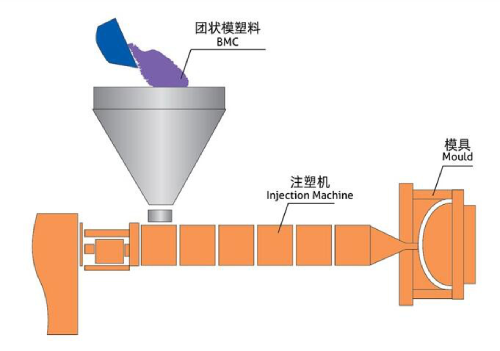
BMC is the initial abbreviation of English Bulk Molding Compound, and the Chinese name is a group molding compound. Pre-mixed into a paste by unsaturated polyester resin, low shrinkage/low profile additive, initiator, internal mold release agent, mineral filler, etc., and then added thickener, colorant, etc., with different lengths of glass fiber, in special Stirring in the kettle is carried out to carry out a thickening process, which finally forms a dough-like intermediate material which can be used for molding and injection molding.

The bulk molding compound manufacturing process basically follows the same rules as the injection mold. However, SMC and BMC molds also have different characteristics from injection molds, such as flow path, exhaust, heating, cavity pressure and balance, parting structure, mold steel used and precision, shrinkage and injection molds. Differently, the BMC mold is molded at a high temperature, and the plastic mold is molded at a normal temperature.


SMC BMC molds require heating rather than cooling systems. The temperature of the mold is usually between 130 and 160. It is very important to keep the temperature of the mold and the exhaust gas when designing the mold. The mold is easier to fill, the product is not easy to be deformed, and the surface is better. Commonly used heating systems are steam, oil and electric heating rods.


Vacuum assisted systems for BMC injection moulds and SMC molds: Products with Class A surfaces are usually vacuum-assisted, and the internal cavity and vacuum insulation of the mold are very important. The mold must have a sensor and a vacuum system to measure the mold temperature and pressure vacuum. Production SMC and BMC molds must guarantee high quality, long life and economy. As one of the most professional sheet molding compound suppliers  in China, Aobang Technology Co., Ltd.'s years of experience in the production of SMC and BMC molds and proficiency in machine, mold, material and process can ensure the maximum benefit of customers.


Zhejiang Aobang Technology Co., Ltd., established in 2010, is a backbone enterprise that manufactures composite moulding at home and abroad. We sincerely hope to establish long-term and strong partnership with domestic and foreign businesses and business circles. We hope to gain recognition and support from our customers and to develop mutual cooperation.  Just feel free to contact us!8466583461?profile=original8466583285?profile=original8466670864?profile=original

Read more…

BMC/SMC Motor

SMC / BMC Motor Description


BMC electric motor replaces traditional iron and aluminum, reduces the process, seals more, and has higher safety factor. It mainly refers to white goods and public motors. High insulation, chemical resistance, high fire resistance, good water resistance, accurate size, stable working performance, light weight, high strength, acid and alkali resistance, waterproof and moisture proof.


BMC/SMC Motors List


The motor range is wide, including: servo motor, plastic edging motor, plastic encapsulations product, BMC rotor, BMC stator, air conditioner motor, refrigerator motor, washing machine motor, DC motor, AC motor, automobile motor, power tool rotor, range hood motor, Motor end cap, motor bracket.


Zhejiang Aobang Technology Co., Ltd., established in 2010, is a backbone enterprise that manufactures smc composite at home and abroad. We sincerely hope to establish long-term and strong partnership with domestic and foreign businesses and business circles. We hope to gain recognition and support from our customers and to develop mutual cooperation.  Just feel free to contact us!8466576691?profile=original8466674100?profile=original8466577264?profile=original

Read more…

Frame Moulding

Frame Moulding Features


Mainly for pressure molding, the cavity pressure should be considered as small as possible when designing the parting surface. The exhaust should be smooth, the position of the discharge, the shape, and the flow of the material should be fully considered, especially for some small ribs. For the movable exhaust, there must be a overflow trough. Vacuuming structure, the mold temperature balance is consistent. The appearance and strength of the product are guaranteed.


Frame Moulding List


Strong plasticity, precise size, high insulation and high temperature resistance. The bmc frame moulding has a high degree of standardization, reasonable flow channel design, small cavity pressure, balanced temperature, no handle, and low power consumption.


Zhejiang Aobang Technology Co., Ltd. is one of the most professional sheet molding compound manufacturers in China, and we hope to gain recognition and support from our customers and to develop mutual cooperation.8466577300?profile=original

Read more…

BMC/SMC Insulation

BMC/SMC Insulation

High-strength, wear-resistant, fire-resistant, SMC insulated, color BMC material for medium and low voltage insulators. Typical applications are switch boards, busbars, switchgear, etc. BMC (Body Molding Plastics) is a blend of glass fiber reinforced polyester resin and chemical mineral materials with special properties such as electrical insulation, low density, high mechanical strength and fire resistance. High sealing, high safety, low process and low cost.


Zhejiang Aobang Technology Co., Ltd. is one of the most professional sheet molding compound manufacturers in China, and we hope to gain recognition and support from our customers and to develop mutual cooperation.8466577281?profile=original8466577479?profile=original

Read more…

BMC/SMC Motor

BMC/SMC Motor Description


BMC plastic edging motor replaces traditional iron and aluminum, reduces the process, seals more, and has higher safety factor. It mainly refers to white goods and public motors. High insulation, chemical resistance, high fire resistance, good water resistance, accurate size, stable working performance, light weight, high strength, acid and alkali resistance, waterproof and moisture proof.


BMC/SMC Motor List


The BMC electric motor range is wide, including: servo motor, plastic edging motor, plastic encapsulations product, BMC rotor, BMC stator, air conditioner motor, refrigerator motor, washing machine motor, DC motor, AC motor, automobile motor, power tool rotor, range hood motor, Motor end cap, motor bracket.


Zhejiang Aobang Technology Co., Ltd. is one of the most professional sheet molding compound manufacturers in China, and we hope to gain recognition and support from our customers and to develop mutual cooperation.

 8466576691?profile=original8466577264?profile=original8466577462?profile=original

Read more…

BMC/SMC Insulation

High-strength, wear-resistant, fire-resistant, color BMC Insulation material for medium and low voltage insulators. Typical applications are switch boards, busbars, switchgear, etc. BMC (Body Molding Plastics) is a blend of glass fiber reinforced polyester resin and chemical mineral materials with special properties such as electrical insulation, low density, high mechanical strength and fire resistance. High sealing, high safety, low process and low cost.

f:id:huzhouaobang:20190907200929j:plain


Read more…

Frame Moulding

BMC Frame Moulding mainly for pressure molding, the cavity pressure should be considered as small as possible when designing the parting surface. The exhaust should be smooth, the position of the discharge, the shape, and the flow of the material should be fully considered, especially for some small ribs. For the movable exhaust, there must be a overflow trough. Vacuuming structure, the mold temperature balance is consistent. The appearance and strength of the product are guaranteed.

f:id:huzhouaobang:20190907201329j:plain

Strong plasticity, precise size, high insulation and high temperature resistance. The mold has a high degree of standardization, reasonable flow channel design, small cavity pressure, balanced temperature, no handle, and low power consumption.

Read more…

🔥Christian Music News