Chapter 1: Why Are Large-Scale Agricultural Projects Increasingly Choosing Multi-Span Greenhouses?
As agriculture becomes more large-scale, intensive, and technology-driven, greenhouse requirements have evolved beyond simply providing growing space. Large agricultural projects increasingly focus on land utilization, production efficiency, and climate control. By connecting multiple growing spans into one continuous structure, multi-span greenhouses can better support large-scale commercial cultivation.
1. Integrated Structures Improve Land Utilization
Compared with multiple independent greenhouses, multi-span structures can reduce duplicated passages and unused edge spaces between individual houses. This allows large projects to make more efficient use of limited land and create continuous production areas.
2. Better Suited to Large-Scale Production and Centralized Management
Multi-span greenhouses provide large, continuous growing spaces that facilitate centralized ventilation, shading, cooling, fertigation, and climate-control systems. This layout can simplify farm management, improve equipment utilization, and provide a suitable foundation for further automation and smart farming applications.
3. Suitable for Different Large Agricultural Projects
From large-scale vegetable cultivation and flower production to seedling cultivation and modern agricultural industrial parks, multi span greenhouses can be adjusted according to project scale, crop type, and climate conditions. Therefore, when selecting multiple greenhouses for large-scale agricultural projects, the core is not to pursue uniform standards, but to match actual production goals through reasonable structure and system design.
Chapter 2: How Can Multi-Span Greenhouses Improve Production Efficiency?
For large-scale agricultural projects, production efficiency depends not only on growing area but also on land utilization, equipment integration, workflow, and climate control. With connected spans and centralized layouts, multi-span greenhouses provide efficient growing spaces and help commercial growers build a more organized production system.
1. Connected Layouts Improve Effective Growing Space
Multi-span greenhouses connect multiple growing units into one integrated structure, reducing duplicated edge spaces and passages between independent houses. For large commercial projects, this layout can make better use of available land while simplifying the planning of growing areas, transport routes, and supporting facilities.
2. Centralized Equipment Improves Management Efficiency
The continuous interior space of a multi-span greenhouse is well suited to centralized ventilation, shading, cooling, and fertigation systems. Proper system planning can reduce duplicated equipment and make it easier to manage multiple growing areas through a unified setup.
3. Supporting Automation and Scalable Production
As growing areas expand, manual management becomes increasingly complex. Multi-span greenhouses can accommodate automated irrigation, fertigation, environmental monitoring, and other agricultural technologies, helping standardize production processes and creating opportunities for future smart-farming upgrades.
Therefore, the value of multi span greenhouses lies not only in "building bigger", but also in improving the operational efficiency of the entire agricultural project through spatial integration, equipment centralization, and process optimization. For large commercial growers, a reasonable multi span greenhouse design can enable more effective collaborative utilization of land, equipment, and human resources.
Chapter 3: What Design Factors Determine the Performance of a Multi-Span Greenhouse?
The performance of a multi-span greenhouse depends on more than its total area. Local climate, structural parameters, covering materials, and environmental control systems all have a direct impact on project performance. For large-scale agricultural projects, proper design at the planning stage can significantly affect production efficiency, operating costs, and service life.
1. Are Local Climate Conditions Properly Considered?
Wind speed, snow, rainfall, temperature, and humidity all influence greenhouse design. The structural loads, drainage, ventilation, insulation, and cooling systems should be determined according to the actual climate conditions of the project rather than relying on a one-size-fits-all solution.
2. How Should Span, Height, and Column Spacing Match Production Needs?
The span, eave height, and column spacing affect not only space utilization but also equipment installation, worker operations, machinery access, and future automation. For large projects, these parameters should be determined based on crop type, growing methods, equipment requirements, and planned production area.
3. How Should the Covering Material Be Selected?
Glass, polycarbonate panels, and PE/PO film offer different levels of light transmission, insulation, impact resistance, and service life. Selection should not be based solely on material price. Climate, crop light requirements, insulation needs, budget, and long-term maintenance costs should all be considered.
4. Can the Environmental Control Systems Work Effectively with the Greenhouse Structure?
Large multi-span greenhouses often require ventilation, shading, cooling, irrigation, and fertigation systems. For large-scale or high-value crops, environmental monitoring and automated control can also be integrated to create a more stable growing environment. The required installation space and operating conditions should be considered during the structural design stage.
A multi-span greenhouse is therefore more than simply expanding the growing area. The structure, covering materials, environmental control systems, and production methods need to work as an integrated solution. Project-specific design helps balance space utilization, production efficiency, and long-term operating costs.
Chapter 4: How Should Different Large-Scale Agricultural Projects Choose a Multi-Span Greenhouse Solution?
Different large-scale agricultural projects have different crop types, production cycles, investment budgets, and automation requirements. Therefore, there is no single multi-span greenhouse solution for every project. The right configuration should be determined based on project scale, crop type, local climate, production goals, and long-term operation plans.
1. What Should Large-Scale Vegetable Projects Consider?
Commercial vegetable projects growing tomatoes, cucumbers, peppers, lettuce, and other crops often require stable temperature, humidity, and light conditions, together with efficient irrigation and fertigation. For large-scale, long-term production, multi-span glass or polycarbonate greenhouses can be considered, with ventilation, shading, cooling, irrigation, and fertigation systems selected according to the local climate.
2. What Matters for Flower and Nursery Projects?
Flower and nursery projects often place greater emphasis on light, temperature and humidity control, and environmental stability. For high-value flowers or year-round nursery production, multi-span greenhouses provide continuous growing space and allow easier integration of shading, ventilation, cooling, and environmental monitoring systems for more precise crop management.
3. How Should Modern Agricultural Parks and Integrated Projects Be Configured?
Modern agricultural parks may combine vegetable production, nursery facilities, research, demonstration, and agricultural tourism. These projects require more flexible greenhouse planning. Different spans, covering materials, and system configurations can be used for different functional zones, while space can be reserved for transportation routes, equipment, and future expansion.
4. How Should High-Value Crop Projects Be Designed?
For high-value crops such as strawberries, specialty vegetables, and flowers, greenhouse selection often focuses more on environmental control and year-round production. The greenhouse can be equipped with suitable climate-control systems based on crop requirements for temperature, humidity, light, and ventilation, together with automated irrigation, fertigation, and environmental monitoring.
Overall, when selecting multiple greenhouses for large-scale agricultural projects, procurement should not simply follow the principle of 'the larger the project, the higher the greenhouse configuration'. A more reasonable approach is to first clarify the crops and production goals, and then determine the structure and system configuration based on local climate, planting methods, budget, and automation requirements. Only in this way can the greenhouse truly serve long-term production, rather than just meeting the initial construction needs.
Chapter 5: What Multi-Span Greenhouse Solutions Does Zheyang Agriculture Provide?
As a professional greenhouse design and manufacturing supplier in China, Zheyang Agriculture provides a range of multi-span greenhouse solutions for large-scale agricultural projects. Rather than simply offering standardized greenhouse products, we develop tailored structural and system configurations based on the project location, climate, crop type, growing area, budget, and production goals.
1. Multi-Span Glass / Venlo Greenhouses
For high-value crops, year-round production, and modern large-scale agricultural projects, Zheyang Agriculture can provide multi-span glass and Venlo greenhouse solutions. Depending on project requirements, systems such as roof and side ventilation, shading, cooling, irrigation, fertigation, and environmental control can be integrated to support large-scale production.
2. Multi-Span Polycarbonate Greenhouses
Multi-span polycarbonate greenhouses combine light transmission, insulation, and structural protection, making them suitable for vegetable production, nurseries, flowers, and commercial projects requiring a relatively stable growing environment. Zheyang Agriculture can select suitable panel thicknesses and structural configurations according to local climate and crop requirements, together with appropriate ventilation, shading, and cooling systems.
3. Multi-Span Film Greenhouses
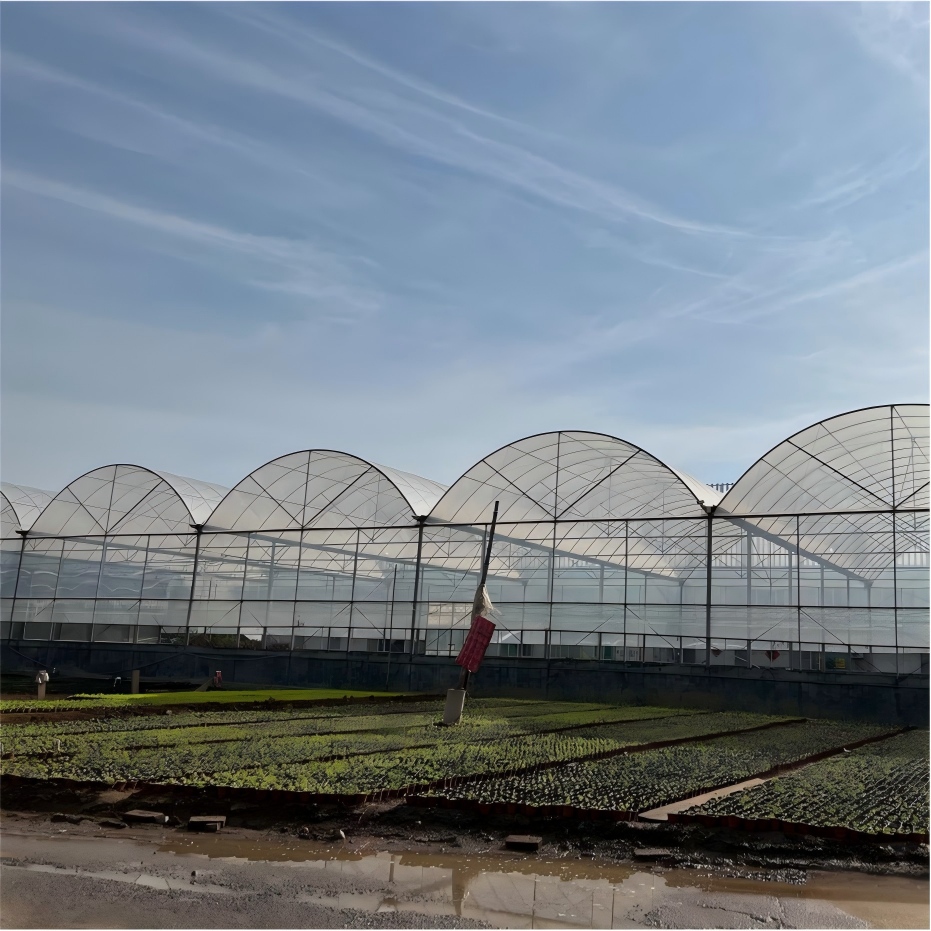
For agricultural projects requiring greater budget flexibility, faster construction, or phased expansion, multi-span film greenhouses offer a flexible solution. PE/PO film can be selected according to project requirements, while roll-up ventilation, roof ventilation, shading, drip irrigation, and fertigation systems can be integrated for large-scale cultivation.
4. How Does Zheyang Approach Project-Specific Greenhouse Design?
Zheyang Agriculture takes a project-specific approach by integrating greenhouse structure, span, eave height, covering material, ventilation methods, and environmental control systems. For large-scale projects, equipment layout, internal logistics, future automation, and expansion can also be considered during the design stage, helping the greenhouse support both current construction and long-term production plans.
Whether the project requires a multi-span glass greenhouse, Venlo greenhouse, polycarbonate greenhouse, or film greenhouse, Zheyang Agriculture focuses on tailored greenhouse design and manufacturing based on actual project requirements, helping customers achieve a practical balance between space utilization, production efficiency, environmental control, and long-term operation.
Chapter 6: What Should Large-Scale Agricultural Projects Consider When Purchasing a Multi-Span Greenhouse?
For large-scale agricultural projects, multi-span greenhouses often involve significant construction areas and long-term operational investment. Therefore, purchasing decisions should not be based solely on the price per square meter. Structural safety, material specifications, system configuration, supplier engineering capabilities, and future expansion potential should all be evaluated.
1. Are Structural Parameters and Material Specifications Clearly Defined?
Buyers should clearly confirm the greenhouse span, eave height, column spacing, steel specifications, corrosion protection, and design loads. Structural design should also account for local wind, snow, rainfall, and other climate conditions rather than relying solely on the lowest-priced quotation.
2. Do the Covering Materials and Systems Match the Project?
Glass, polycarbonate panels, and PE/PO film differ in light transmission, insulation, weather resistance, and service life. Buyers should also confirm the specific configurations of ventilation, shading, cooling, irrigation, and fertigation systems to ensure that the greenhouse structure and growing requirements work together effectively.
3. Does the Supplier Have Project-Based Engineering Capabilities?
Large multi-span greenhouses are rarely just standard products. Buyers should evaluate whether the supplier can develop a solution based on the project location, crop, area, and production goals, while also providing structural manufacturing, system configuration, and project delivery support.
4. Has Future Expansion and Long-Term Operation Been Considered?
For large-scale agricultural projects, the initial plan should also consider future expansion, equipment upgrades, and automation. A well-planned greenhouse layout can reserve space for transportation routes, equipment installation, and additional growing areas, helping reduce potential modification costs later.
When purchasing a multi-span greenhouse, buyers should therefore look beyond price alone and evaluate the combination of structure, configuration, engineering capability, and long-term operation. For large-scale projects, matching the greenhouse solution to actual production requirements is essential for balancing land utilization, production efficiency, and long-term investment value.
FAQ
Q1: What is a multi-span greenhouse?
A multi-span greenhouse connects multiple greenhouse spans into a continuous growing area. It is suitable for large-scale vegetable production, flower and nursery projects, modern agricultural parks, and other commercial applications. Compared with separate single-span houses, a multi-span layout facilitates centralized management and system integration.
Q2: What types of multi-span greenhouses does Zheyang Agriculture provide?
Zheyang Agriculture provides multi-span glass/Venlo, polycarbonate, and film greenhouse solutions. Each solution can be tailored according to local climate, crop type, project scale, budget, and automation requirements.
Q3: Can Zheyang Agriculture design a multi-span greenhouse based on our project?
Yes. Zheyang Agriculture focuses on tailored greenhouse design and manufacturing rather than simply supplying standardized greenhouse kits. Project location, climate, crop type, growing area, production goals, and equipment requirements can all be considered during the design process.
Q4: Which covering material should I choose for a multi-span greenhouse?
Common options include glass, polycarbonate panels, and PE/PO film. Glass can suit projects requiring high light transmission and environmental control, while polycarbonate offers a balance of light transmission and insulation. PE/PO film provides greater configuration flexibility. Zheyang Agriculture selects the covering solution according to the project's climate, crop requirements, and budget.
Q5: Can greenhouse systems be integrated into a Zheyang multi-span greenhouse?
Yes. Depending on project requirements, Zheyang multi-span greenhouses can integrate roof and side ventilation, shading, cooling, irrigation, fertigation, environmental monitoring, and automated control systems. Equipment layout, internal logistics, and future automation can also be considered during the design stage.
Q6: How does Zheyang Agriculture determine the right greenhouse structure?
Zheyang Agriculture evaluates project location, local wind and snow conditions, crop type, growing method, project area, budget, and production goals before determining the span, eave height, column spacing, covering material, and system configuration.
Ready to Build a Multi-Span Greenhouse for Your Project?
Tell us about your project, and our team can help you evaluate the right greenhouse structure, covering material, and system configuration for your production needs.

Comments