When your office chair slowly sinks to the floor every time you sit down—or worse, refuses to adjust height altogether—it's likely the gas lift for office chair has failed. Many users wonder: Can you fix a gas lift chair? The short answer is yes—but not always by “repairing” the cylinder itself. In most cases, the solution lies in replacement.
Understanding How a Gas Lift Office Chair Works: Mechanics and Standards
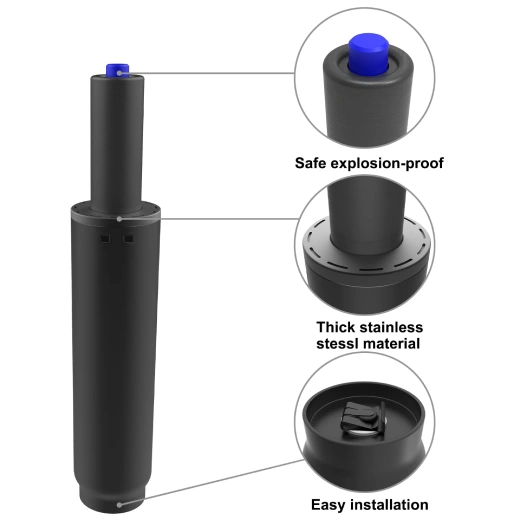
At the heart of every height-adjustable swivel chair is a pneumatic gas lift cylinder—often mistaken for a simple spring mechanism. In reality, it's a precision-engineered component filled with pressurized nitrogen gas and oil. When you pull the height adjustment lever, it opens a valve inside the cylinder, allowing the piston to move up or down under your body weight. Releasing the lever seals the valve, locking the chair at your desired height.
Not all gas lifts are created equal. Quality is typically classified into Class 1 through Class 4, with Class 4 offering the highest load capacity and durability—often rated for 250 kg or more. Industry certifications like BIFMA (Business and Institutional Furniture Manufacturers Association) set rigorous testing standards for safety, cycle life (typically 30,000+ up/down motions), and structural integrity. A chair labeled “BIFMA-compliant” means its gas lift for office chair has passed real-world stress simulations, making it suitable for heavy daily use in offices, schools, or commercial settings.
Many users overlook these classifications, opting for cheap replacements that degrade within months. Understanding these technical benchmarks is crucial when evaluating whether a failing gas lift can be salvaged—or must be replaced with a high-grade alternative.
Diagnosing Common Gas Lift Failures: Is It Really Broken?
Before jumping to conclusions, it's essential to confirm that the gas lift office chair is indeed the culprit. Several symptoms mimic gas lift failure but stem from other components:
Gradual sinking: The most telltale sign of gas leakage inside the cylinder. If your chair lowers over seconds or minutes while you're seated, the internal seal has likely failed.
Stuck at one height: Could indicate a jammed control lever, worn mechanism, or seized piston—not necessarily a dead gas lift for office chair.
Unusual noises (hissing, clunking): Hissing suggests gas escaping; clunking may point to loose mounting hardware or a damaged star base.
True gas lift failure is almost always irreversible. Unlike mechanical parts, the sealed nitrogen chamber cannot be refilled or repressurized outside industrial settings. DIY “fixes” like hammering the cylinder or adding external supports are unsafe and ineffective. The safest, most reliable solution is full replacement—especially if the chair is used daily or supports heavier users.
How to Separate Gas Lift from Office Chair: A Step-by-Step Safety Guide
Replacing a gas lift requires removing it from both the chair base and the seat mechanism. Many users ask: How to separate gas lift from office chair without damaging other parts? Here's a professional-grade approach:
Turn the chair upside down on a soft surface (e.g., carpet or foam pad) to protect finishes.
Locate the retaining clip or C-ring at the base of the gas cylinder where it meets the star base. Some models use a plastic collar instead.
Use a flathead screwdriver or specialized removal tool to gently pry out the retaining clip. Do not strike the cylinder directly with a hammer—this can rupture the pressurized chamber.
Apply controlled force: Place a block of wood on top of the cylinder and tap downward with a mallet. The piston should slide out of the seat mechanism. If stuck, apply penetrating oil and let it sit for 15 minutes.
Inspect the chair base and mounting plate for cracks or deformation before installing the new lift.
Safety note: Never heat, drill, or puncture a gas lift cylinder. Even “empty” units may retain pressure and pose explosion risks. Always wear safety goggles during removal.
When sourcing a replacement, prioritize cylinders that match your chair's stroke length (common sizes: 65mm, 85mm, 100mm, 120mm) and load class. Reputable suppliers like Foshan Growing Furniture Co., Ltd. offer BIFMA-certified heavy-duty gas lifts in chrome or black finishes, engineered for compatibility with executive, mesh, and swivel chairs across residential and commercial environments.
Choosing the Right Replacement: Long Term Reliability Over Quick Fixes
Given that gas lifts are wear items with finite lifespans (typically 3–7 years under normal use), investing in a high-quality replacement pays dividends. Look for these indicators:
BIFMA certification: Non-negotiable for office or institutional use.
Class rating: Class 3 or 4 for users over 90 kg or chairs used >6 hours/day.
Material quality: Chrome plated steel resists corrosion better than painted alternatives.
Manufacturer transparency: Reputable brands disclose testing data, material specs, and warranty terms.
While some online retailers sell unbranded gas lifts for under $10, these often lack pressure testing and fail prematurely—sometimes catastrophically. In contrast, industrial-grade replacements may cost slightly more but ensure years of stable performance and user safety.
Companies with vertical integration—like those that manufacture casters, bases, mechanisms, and gas lifts in-house—often provide better compatibility and technical support. Their deep understanding of chair ergonomics and component interaction leads to more reliable system level performance.
FAQ: Your Top Questions About Gas Lift Chairs Answered
Q: Can you fix a gas lift chair without replacing the cylinder?
A: No. Once the internal seal fails or gas leaks, the cylinder cannot be repaired. Replacement is the only safe and effective solution.
Q: How long should a gas lift for office chair last?
A: With moderate use, a Class 3 or 4 BIFMA-certified lift should last 5+ years. Heavy daily use may reduce lifespan to 2–3 years.
Q: Is it dangerous to remove a gas lift myself?
A: It's safe if done carefully. Never strike the cylinder directly. Use wood blocks and mallets for controlled force, and always wear eye protection.
Q: What size gas lift do I need?
A: Measure the extended and compressed lengths of your current cylinder. Common strokes are 65mm, 85mm, 100mm, and 120mm. Match both length and diameter (typically 50mm outer diameter).
Q: Can I upgrade to a higher-class gas lift?
A: Yes—and it's recommended if your chair supports heavier users or sees intensive use. Ensure the new lift fits your chair's mounting interface.
Q: Why does my new gas lift feel stiff?
A: New cylinders often require a few up/down cycles to break in. If stiffness persists after 20–30 adjustments, check for misalignment or incompatible mechanisms.
In conclusion, while you can't truly “fix” a failed gas lift, understanding its function, diagnosing issues accurately, and selecting a high-grade replacement empowers you to restore your chair's performance safely and effectively. Whether you manage a corporate office or simply rely on your home desk chair, prioritizing certified components like BIFMA-compliant gas lift office chair cylinders ensures comfort, safety, and longevity.
Upgrade your workspace with FSGROWING's premium gas lift for office chair — crafted for exceptional durability, smooth mobility, and contemporary design. Engineered to deliver outstanding stability and long lasting performance, this gas lift office chair is the perfect solution for modern professional environments.

Comments